
Cursive Practice Sheets: Free Printable PDF (Easy 7-Day Plan)
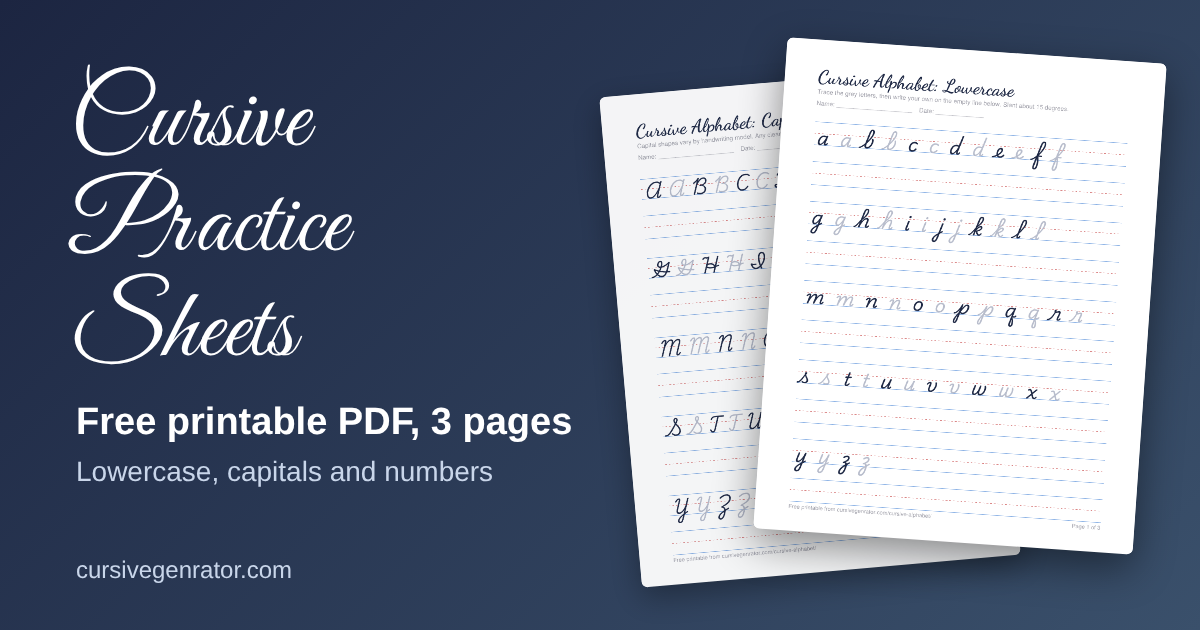
Good cursive practice sheets do one thing well: they let you trace a clean model letter, then write the same letter on your own, on lines that show you exactly where it should sit. This page gives you a free set of cursive practice sheets as a printable PDF, plus a simple way to use them, a seven-day plan and tips for kids and adults.
The download covers the lowercase alphabet, the capital letters, numbers, words and short sentences. If you want to see how each letter is formed before you start, the guide to how to write in cursive walks through the basic strokes.
Free download: Download the free cursive practice sheets (PDF, 3 pages)
What Is Included in These Free Cursive Practice Sheets
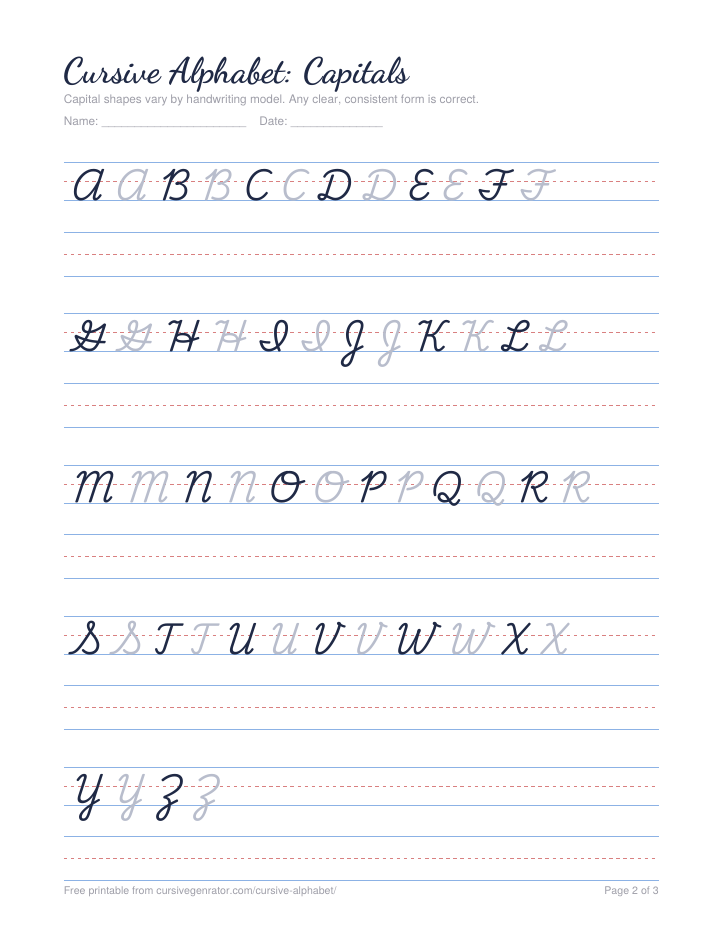
The PDF has three pages, each built on the same layout so you always know what to do. Every row begins with a dark model letter, followed by a grey copy to trace and then an empty line for your own writing.
- Page 1: the full lowercase alphabet, a to z, in groups of six letters.
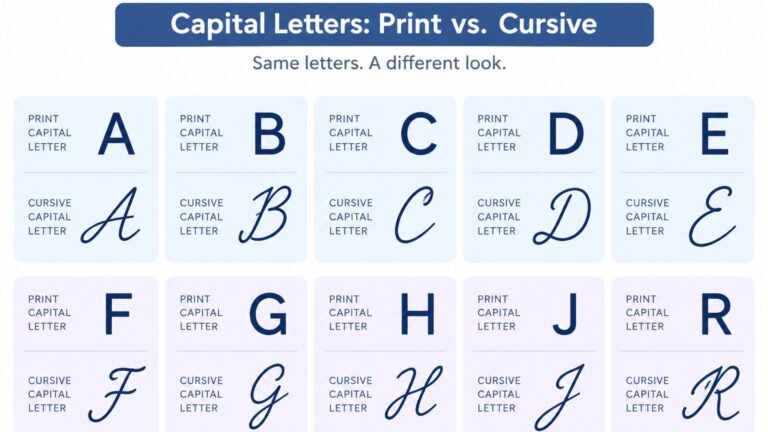
- Page 2: the capital letters, A to Z, in the same layout.
- Page 3: numbers 0 to 9, short words and a few practice sentences.
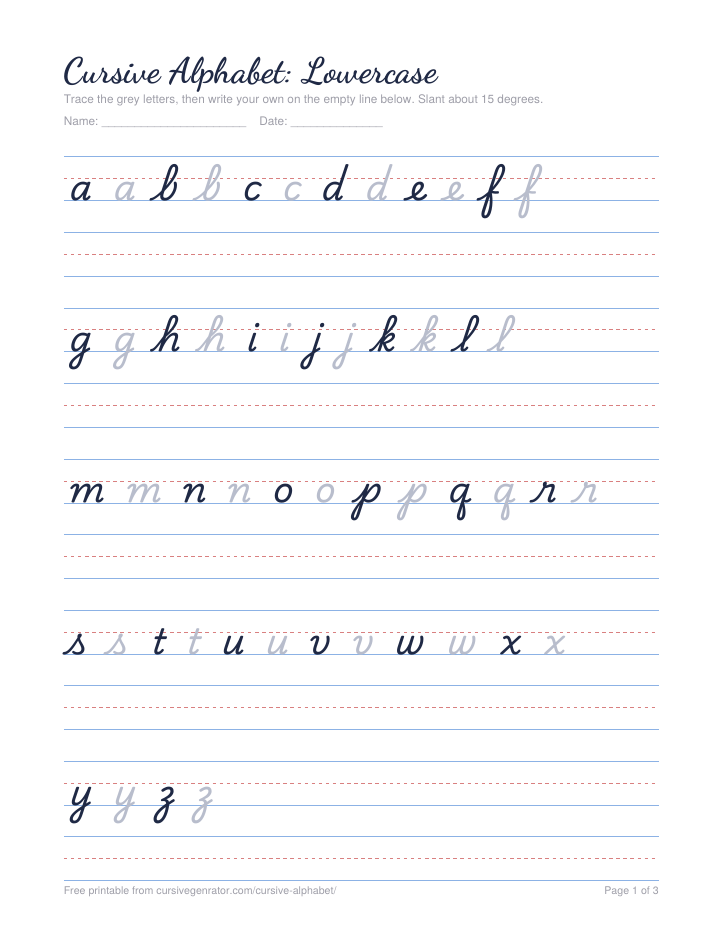
The guide lines show a baseline, a dashed midline and a top line. Most lowercase letters sit between the baseline and the midline, tall letters reach the top line and letters like g, j and y drop below the baseline.
How to Use Cursive Practice Sheets Step by Step
Printing the sheets is the easy part. How you use them decides whether your handwriting really improves. Follow these steps.
- Print on plain white paper at 100 percent size, without scaling, so the guide lines stay accurate.
- Use a pencil first. You can erase, and light pressure helps you stay relaxed.
- Trace the grey letter slowly, following the stroke path, then write the letter on the empty line below.
- Write each letter three to five times before moving on, and check height and slant against the lines.
- Finish with a short word that uses the letter, so you practice the join and not only the shape.
Short, focused sessions work better than long ones. Ten to fifteen minutes a day is enough, and it is better to repeat a few letters well than to rush through the whole alphabet.
Cursive Worksheets PDF: Print, Trace and Write
People search for cursive practice sheets and cursive worksheets almost interchangeably, and the PDF on this page is both. It is a free cursive worksheets PDF with tracing rows, copy lines and empty lines for your own writing, so it works for home practice, homeschooling or a classroom warm-up.
Because it is a standard PDF, you can print as many copies as you need, or open it on a tablet and write with a stylus. Print a fresh page whenever you want to repeat a row without the earlier attempts on it.
Cursive Practice Sheets for Adults
Many adults want cursive practice sheets because they never learned joined handwriting, or because they stopped using it years ago. The same sheets work well for you. The difference is mostly in approach, not materials.
- Start with lowercase letters only. The capital letters are harder and can wait a week.
- Use a comfortable pen once you are past the pencil stage, because pressure and grip matter more for adults who write less often.
- Slow down. Speed will come, and a steady slant is worth more than a fast scribble.
- Write real things, such as a shopping list or a short note, after the first few days.
If you are working toward a personal signature, learn the basic shapes first and then see our guide on how to create a cursive signature.
Cursive Writing Practice Sheets for Kids and Classrooms
Teachers and parents can use these cursive writing practice sheets as a warm-up or a take-home page. Keep the first sessions short, and let children trace with a pencil before moving to a pen. Different schools teach slightly different letter forms, so if your class uses a specific handwriting program, treat these sheets as a general model and follow your program for the exact shapes.
For a younger learner, begin with the letters that share a shape. Our cursive alphabet chart groups the lowercase letters into shape families, which makes the order easier to teach.
A 7-Day Plan for Your Cursive Practice Sheets
Here is a simple weekly routine. Spend ten to fifteen minutes each day.
- Day 1: lowercase a to f. Trace, then write each letter three times.
- Day 2: lowercase g to l, then review a to f.
- Day 3: lowercase m to r, then write one short word with each new letter.
- Day 4: lowercase s to z, then review the weakest letters from days 1 to 3.
- Day 5: numbers 0 to 9 and the sentences on page 3.
- Day 6: capital letters A to M. See the guide to capital cursive letters for each shape.
- Day 7: capital letters N to Z and a full sentence of your own.
After the first week, repeat the sheets and try to write without tracing. Your second pass will usually look noticeably cleaner than your first.
What to Practice After the Basic Sheets
Once the alphabet feels comfortable, move from single letters to words. Our guide on writing cursive words and connecting letters explains how each join works, and the words to write in cursive page has word lists sorted by the letters they train. When you are ready for longer lines, try these cursive sentences with a second free worksheet.
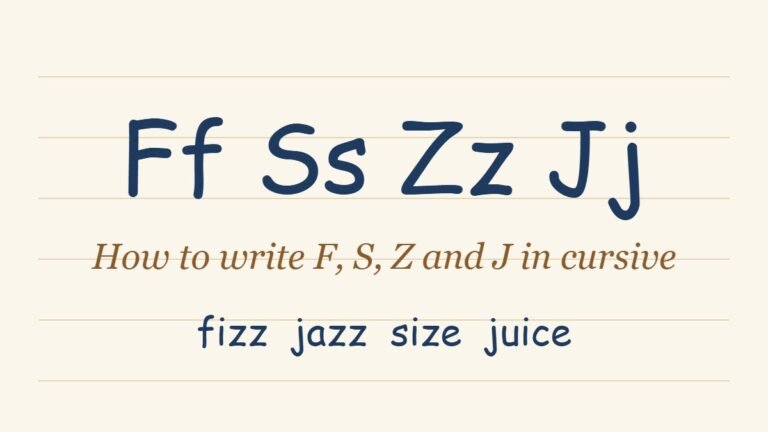
If particular letters keep going wrong, use the letter-by-letter guides, for example how to write F, S, Z and J in cursive or how to write B, L, M and T in cursive.
Tips to Get More From Your Cursive Practice Sheets
- Sit upright with your forearm resting on the table and tilt the paper slightly for a natural slant.
- Hold the pen lightly. A tight grip causes cramped, shaky letters.
- Write from the arm and shoulder, not only from the fingers, so the strokes stay smooth.
- Keep one slant throughout the page, usually 15 to 20 degrees to the right.
- Re-print a clean copy of any page you want to try again, so you always have a fresh model to trace.
Common Mistakes When Using Cursive Practice Sheets
- Tracing too fast. The point is to feel the stroke, not to finish the row.
- Skipping the empty line. Tracing alone does not teach you to write from memory.
- Changing the size of the letters. Keep each one between the lines.
- Practicing only single letters. Words are where the joins are learned.
- Practicing for an hour once a week. Short daily sessions beat long irregular ones.
Preview a Word Before You Write It
If you want to see how a word or name looks in joined letters before you write it, type it into our free cursive generator. It is a visual reference that shows your text in several cursive styles, and it works well alongside your cursive practice sheets. For names, try the cursive name generator.
Ready to practice? Download the free cursive practice sheets (PDF, 3 pages)
Frequently Asked Questions
Are these cursive practice sheets free?
Yes. The PDF is free to download and print for personal or classroom use.
Are these free printable cursive worksheets?
Yes. The cursive worksheets PDF on this page is free to download and print for personal or classroom use, with no sign-up.
What size should I print them at?
Print at 100 percent on standard letter or A4 paper. Scaling the page changes the spacing of the guide lines.
Can adults use cursive practice sheets?
Yes. The sheets work for any age. Start with lowercase letters, use a pencil at first and keep sessions short.
How long does it take to learn cursive?
It depends on how often you practice. Most people see clear improvement after a week of short daily sessions, and a comfortable handwriting style takes a few weeks.
Should I trace or write freehand?
Do both. Trace first to learn the stroke, then write on the empty line. The empty line is where you learn to produce the letter yourself.
Which letters should I practice first?
Begin with lowercase letters that share a shape, such as a, c and d, then move to the others. Capital letters can wait until the lowercase letters feel steady.
Conclusion
Cursive practice sheets work best when you trace, write, check and repeat in short daily sessions. Print the PDF, follow the seven-day plan and move on to words once the letters feel steady. You can also read the overview of cursive on Wikipedia for some background on the script.

One Comment