
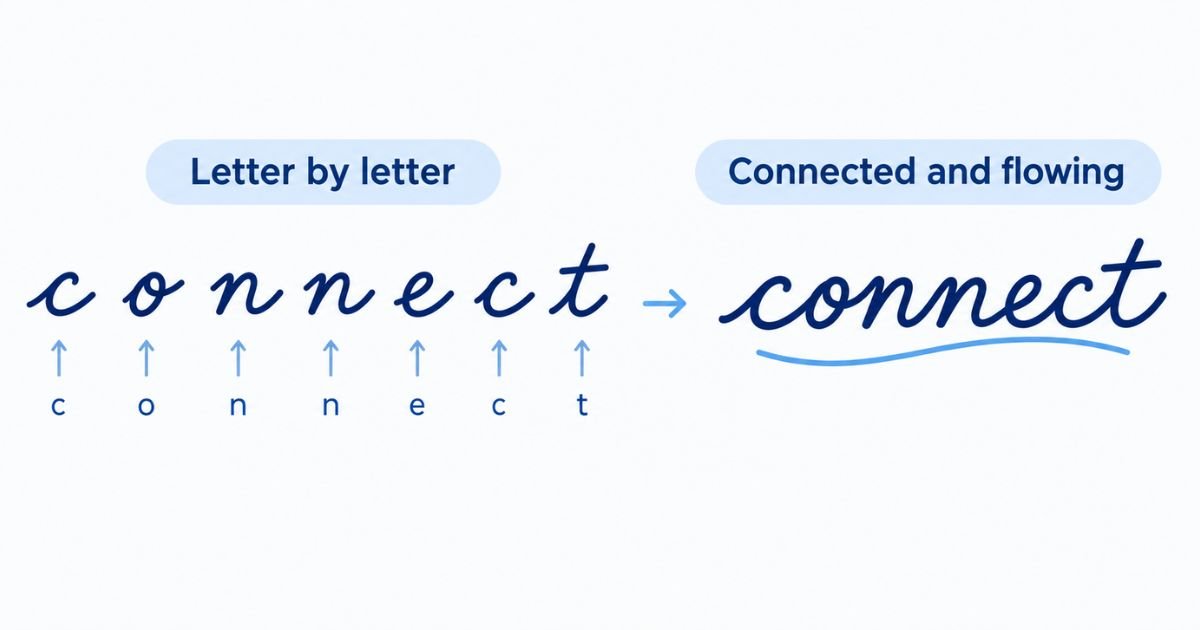
How to Write Cursive Words: Connecting Letters Smoothly
New to cursive? Start with the complete beginner’s guide to writing in cursive before working through the connections below.
Individual letters are only half of cursive writing. The other half, and the part that actually makes writing look and feel like cursive, is what happens at the seams between letters. A page of perfectly formed individual letters that never connect is not cursive, it is print with extra curves. This guide covers how cursive letters actually connect into words, the specific letter combinations that behave differently from each other, the words that give beginners the most trouble, and the mistakes that make an otherwise well-practiced word fall apart.
Why Connecting Letters Is the Real Skill in Cursive
Most beginners spend the bulk of their early practice on individual letter shapes, which makes sense since a letter has to be recognizable before anything else matters. But letter shape is not what defines cursive as a style. Print letters can be shaped beautifully and still be print. What makes writing cursive is that the letters inside a word connect in one continuous motion, without lifting the pen between them.
This is also where cursive actually earns its reputation for speed. Lifting and repositioning the pen between every letter, the way print writing works, is what slows print down. A cursive writer who has the connections down loses almost no time between letters, since the pen is already moving toward the start of the next one before the current letter is even finished.
This means practicing connections is not a secondary skill you pick up after letters. It is close to being the main skill. Two people can know the same 26 letter shapes and produce very different handwriting, because one of them has practiced smooth, consistent connections and the other has not.
A Short History of Connected Cursive Writing
Connected, continuous-stroke handwriting was not invented for aesthetic reasons. It grew out of a practical need: writing quickly and legibly with a dip pen or an early fountain pen, tools where lifting the pen constantly was slow and where a fresh dip of ink made every unnecessary stroke costly. Spencerian script, developed in the mid-1800s, formalized connected writing into a teachable system built around this exact efficiency.
The Palmer Method, which took over American classrooms in the early 1900s, kept the same core principle while simplifying the more ornamental Spencerian flourishes. Its entire teaching method centered on what Palmer called “muscular movement,” training students to keep the whole arm moving in a continuous rhythm rather than making small, stop-start motions with just the fingers. Letters were taught less as individual shapes to memorize and more as connected sequences to be produced in one smooth motion.
That history is why cursive instruction still emphasizes connections over individual letters, even in modern, simplified teaching methods. A letter’s shape can be corrected in isolation. A connection can only be learned by writing letters together, which is why practicing single letters in a row, without ever linking them, only gets a learner partway to writing actual cursive words.
General Rules for Connecting Cursive Letters
A handful of rules govern how letters connect, regardless of which specific letters are involved.
- Match the exit height to what comes next. Most lowercase letters exit at or near the baseline, but the exact height changes depending on the letter that follows. A letter followed by one that starts low, like a, c, d, g, o or q, connects with a short, direct downward curve. A letter followed by one that starts with its own upstroke, like b, e, f, h, k or l, needs the exit stroke to rise slightly so the transition does not look cramped or collide with the next letter’s rising stroke.
- Keep connecting strokes short and consistent. A connecting stroke that is too long creates visible gaps that break the continuous look of the word. One that is too short crowds adjacent letters into each other. The right length stays consistent across an entire word rather than varying letter to letter.
- Do not lift the pen mid-word. This is the single rule that defines cursive as a style rather than a set of connected-looking print letters. A brief lift can be acceptable at natural pause points, like after crossing a t or dotting an i, done afterward rather than mid-letter, but lifting in the middle of forming a letter or its connection defeats the purpose of writing in cursive at all.
- Keep the baseline steady through the whole word. A connection that drifts upward or downward across a word is one of the fastest ways to make otherwise well-formed letters look uneven, even when each individual letter is shaped correctly.
How Different Letter Combinations Connect
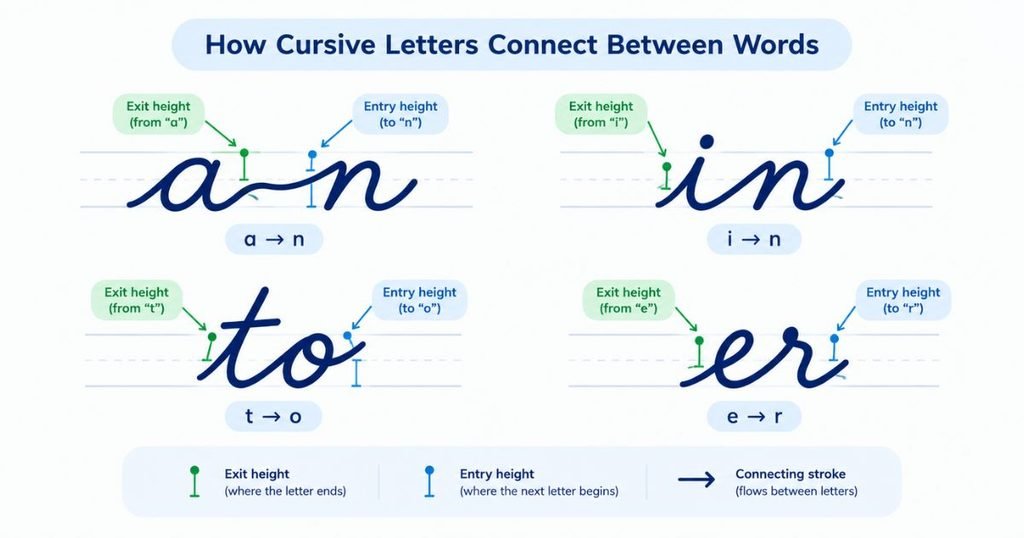
Not every letter pair connects the same way. A few patterns cover most of what shows up in real words.
Round letters connecting to round letters, like a to o or c to a, tend to be the easiest combination, since both letters naturally finish and start near the baseline with a similar curve direction. These pairs are a good place to start practicing connections before moving to more demanding combinations.
Round letters connecting to tall letters, like a to l or o to h, require the exit stroke to rise further than usual to meet the tall letter’s upstroke smoothly. Rushing this connection is a common reason a tall letter ends up leaning or starting at the wrong height.
Letters with descenders, like g, j, p, q and y, connecting into the next letter need extra attention, since the pen has to travel back up from below the baseline before it can connect forward. This return stroke should stay smooth and should not be rushed just because it covers more vertical distance than a typical connection.
Capital letters connecting into lowercase letters behave differently from lowercase-to-lowercase connections. Most cursive styles treat a capital as its own independent stroke, finished on its own, with a small visual gap before the lowercase letters that follow rather than one unbroken line straight from the capital into the rest of the word. The full explanation of how capitals behave, including which ones cause the most trouble, is covered in the dedicated guide to capital cursive letters.
Double letters, like the two l’s in “hello” or the two s’s in “class,” are written as two separate letter shapes joined by a short connecting stroke rather than merged into one exaggerated shape. Merging them usually makes the word harder to read, not faster to write, since a reader needs to see two distinct letter shapes to recognize a double letter at a glance.
Common Mistakes When Writing Cursive Words
Most problems with cursive words trace back to how the letters connect, not to how any single letter is shaped.
Lifting the pen mid-word is the most fundamental mistake, since it removes the one feature that actually makes writing cursive. It often happens unconsciously, especially on longer or unfamiliar words, when a writer pauses to think about the next letter and lifts out of habit rather than planning the connection in advance.
Uneven connector length makes some letters look cramped and others look stretched out within the same word. This is usually a speed problem: connections written quickly tend to shrink, while connections written carefully tend to grow, and mixing fast and careful sections within one word produces visibly inconsistent spacing.
Letting double letters blur into one shape removes the visual cue a reader depends on to recognize a doubled letter. Two l’s that merge into a single tall loop, for example, can become difficult to distinguish from a single stylized l.
Forcing a hard connection from a capital into the following lowercase letter, rather than allowing the small natural gap most cursive styles use, is one of the most common reasons a capital letter’s shape collapses partway through a word.
Losing the baseline partway through a word, so that later letters sit noticeably higher or lower than the ones at the start, is common in longer words and full sentences, where small drifts accumulate the further the hand travels across the line.
Why Some Words Are Harder to Connect Than Others
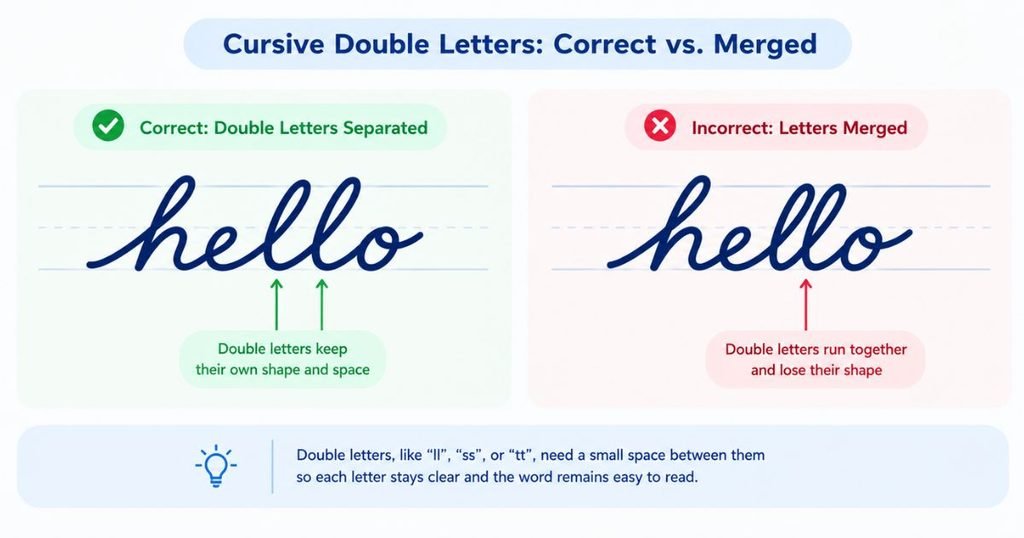
A few categories of words are worth knowing about before you hit them in practice, since they behave differently from an average word.
Words with double letters, like “hello,” “class” or “little,” need the double-letter handling covered above applied consistently, and they are a good test of whether that skill has actually stuck, since a single missed connection makes the double letter far more obvious than it would be in an isolated letter pair.
Words that mix short, round letters with tall, looped letters, like “belly” or “jolly,” force frequent height changes within a very short span, which is exactly the kind of transition covered in the letter-combination rules above. These words are demanding in a small amount of space, which makes them useful practice despite being short.
Words that start with an ornamental capital, especially capital I or capital R, inherit all of the difficulty covered in the dedicated capital letters guide, on top of the normal word-connection rules. A capital that collapses at the very start of a word is often more noticeable than one deeper into a sentence, simply because it is the first thing a reader’s eye lands on.
Very short words, two or three letters long, can be surprisingly harder to connect smoothly than longer ones, since there is no room to build rhythm before the word ends. Longer words let a writer settle into a consistent motion partway through; short words are over before that rhythm really starts.
How Numbers and Capitals Fit Into Cursive Words
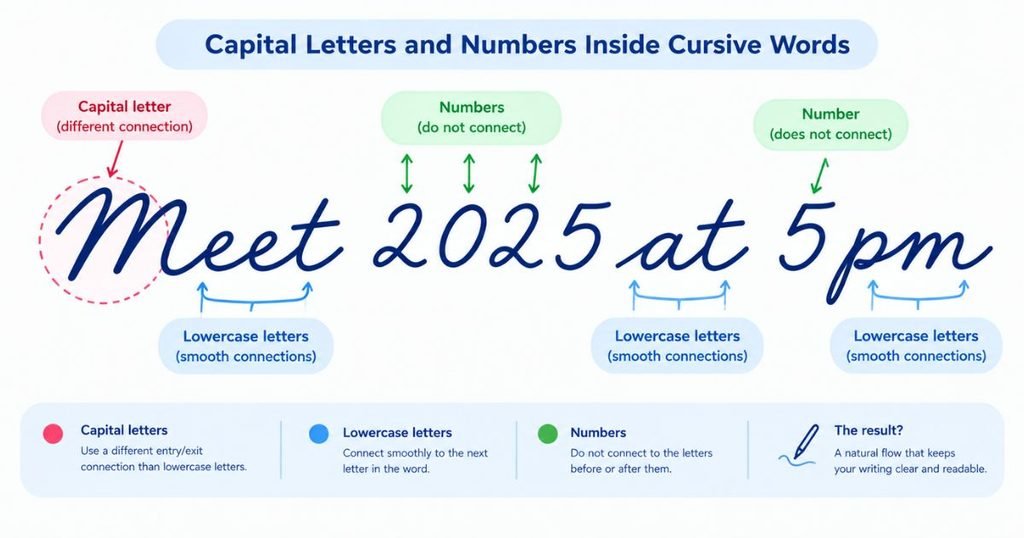
Two categories of characters behave differently from ordinary lowercase letters when they show up inside otherwise cursive writing, and both are worth understanding on their own.
Capital letters, as covered above, are treated as their own independent stroke with a small gap before the lowercase letters that follow, rather than connecting directly the way lowercase letters connect to each other. The dedicated guide to capital cursive letters covers all 26 capitals individually, including the specific pairs that get confused most often.
Numbers behave even more differently, since cursive-style digits do not connect to each other or to the letters around them at all. Each digit is written as its own separate, styled figure rather than joined into the surrounding word the way letters are. The dedicated guide to cursive numbers covers the specific rules for each digit and how they sit inside otherwise cursive text.
Knowing these two exceptions in advance prevents a common source of confusion: trying to force a capital or a number into a continuous connected stroke the way a lowercase letter would work, which produces exactly the kind of collapsed, unnatural shape this guide is meant to help you avoid.
See Your Words in Cursive Style First
Reading about how letters connect is useful, but seeing an actual word rendered in a real script typeface makes the connections themselves far easier to copy by hand.
Cursive Generator converts typed text, including full names and sentences, into genuine cursive-style characters and previews them across several real script fonts at once. Typing a word you plan to practice is a fast way to see exactly how its letters should connect before working through it on paper.
Tips for Practicing Cursive Words
Practicing connections directly, rather than only practicing isolated letters, is what actually improves cursive word writing.
- Start with two-letter combinations before full words. Writing a single connection, like a to n or o to w, over and over builds the specific motion faster than jumping straight into full words where a mistake could come from several different places at once.
- Practice double-letter words on their own. Words like “hello,” “class” or “tell” isolate the double-letter skill specifically, making it easier to notice and fix a merging problem before it shows up in longer writing.
- Write the same word slowly, then at a natural pace. Slow, careful writing builds the correct motion. Writing the same word again at a comfortable speed tests whether that motion has actually become automatic, rather than only working when consciously controlled.
- Check your baseline at the start and end of every word. A quick comparison between where a word starts and where it finishes catches baseline drift before it becomes a habit across full sentences.
Not sure which words to practice first? Our words to write in cursive lists sort easy, hard and fun words by what they train.
Frequently Asked Questions
How do you connect letters in cursive words?
Match your exit stroke height to whatever letter comes next, keep connecting strokes short and consistent, avoid lifting the pen mid-word, and keep every letter sitting on the same baseline as the ones around it.
Why do my cursive letters look connected but still messy?
Uneven connector length is the most common cause, where some connections are rushed and short while others are drawn out and long within the same word. Slowing down and keeping connector length consistent usually fixes this faster than adjusting individual letter shapes.
How do you write double letters in cursive?
Write double letters, like the two l’s in “hello” or the two s’s in “class,” as two separate letter shapes joined by a short connecting stroke, not merged into one exaggerated shape. A reader needs to see two distinct shapes to recognize a doubled letter at a glance.
Do capital letters connect to the rest of a cursive word?
Not the same way lowercase letters do. Most cursive styles treat a capital as its own independent stroke, finished before a small gap leads into the lowercase letters that follow, rather than one unbroken line running from the capital straight into the rest of the word.
Do numbers connect to letters in cursive writing?
No. Cursive-style numbers do not connect to each other or to surrounding letters at all. Each digit is written as its own separate, styled figure, unlike lowercase letters, which are meant to connect in one continuous motion.
What are the easiest cursive words to practice first?
Short words built from round, similarly shaped letters, like “cat,” “add” or “cage,” tend to be easiest, since the connections between them follow the simplest pattern covered in this guide, a direct downward curve from one round letter into the next.
Is it normal for cursive words to look messy at first?
Yes. Connections are a motor skill, and motor skills improve with repetition rather than understanding alone. Writing the same word slowly and correctly many times, then gradually increasing speed, is a more reliable path to clean cursive words than trying to get every word right on the first attempt.
Conclusion
Cursive words come down to how the letters connect, not just how each one is shaped on its own. Match your exit stroke to whatever letter comes next, keep connecting strokes short and consistent, never lift the pen mid-word, and keep every letter on the same baseline as the ones around it. Pay extra attention to double letters, words that mix round and tall letters, and words that open with an ornamental capital. Once those habits are in place, individual letters stop looking like separate shapes stitched together and start reading as genuine, flowing cursive words. To see how a word looks connected before writing it by hand, try Cursive Generator and preview it across several real script fonts.
4 Comments