Words to Write in Cursive: Easy, Hard and Fun Practice Lists
Once you can form the letters, the next question is always the same: which words should I actually practice? Writing “a, b, c” in a row teaches shapes, but it does not teach joins, and joins are what make writing cursive. This guide gives you words to write in cursive, sorted by what they train: easy words to build flow, hard words to fix weak spots, fun and satisfying words that are a pleasure to write, and pretty, kind and seasonal words for cards and journals.
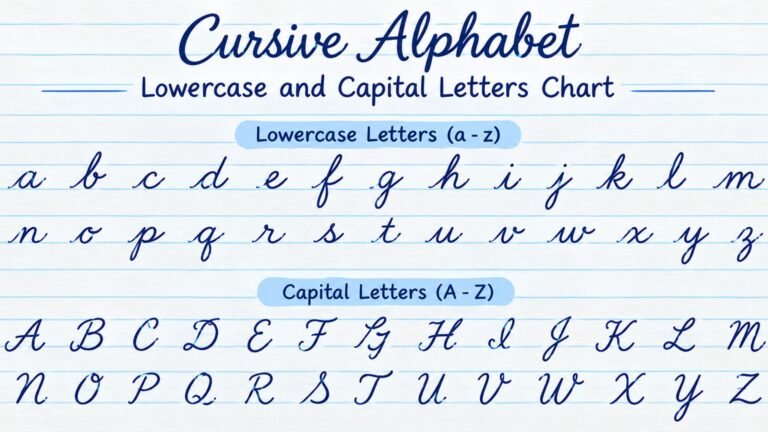
Each list says why the words are there, so you can pick your own as well. If you are still learning the letters, start with the full guide to writing in cursive or the cursive alphabet chart and come back once the shapes feel steady.
How to Choose Words to Practice in Cursive
A good practice word does one of three jobs. It is short and frequent, so it builds speed. It contains a join you find difficult, so it fixes a weakness. Or it is simply enjoyable to write, so you keep going. The best practice mixes all three.
Start with the shortest words, since a mistake in two or three letters is easy to see. Move to everyday words that fill most sentences, then to words with doubled letters and mixed tall and short letters, then to longer words you choose for fun. Writing the same word ten times, slowly, teaches more than writing ten different words once.
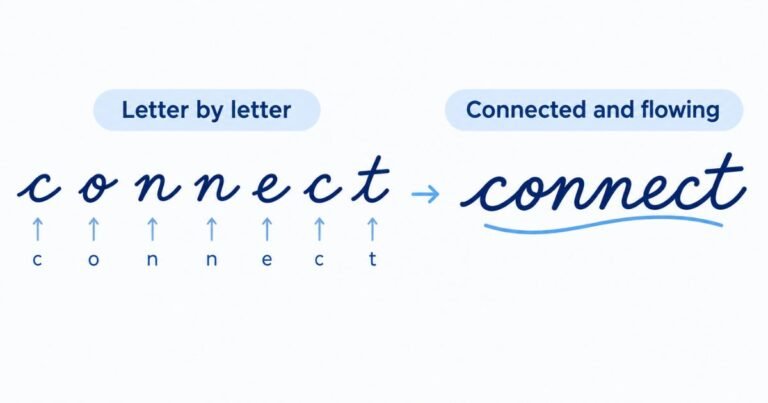
It also helps to know what a join actually is. Nearly every connection in cursive is one of four types, and recognizing which one you are making is half the work. These joins come from the connected-stroke teaching tradition behind the Palmer Method, which spread through American classrooms in the early 1900s.
- The baseline join: Most letters end at the baseline with a small upward exit, and the next letter picks up from there. This covers joins like a to n, i to n and u to n.
- The high join: Letters that finish near the top, namely o, v, w and b, send the exit stroke across at midline height, so the next letter has to start from that higher point rather than from the baseline.
- The loop join: Tall loop letters like l, h, b and k end by coming down to the baseline, so the next letter starts after the retraced stroke instead of after a fresh upstroke.
- The descender join: Letters with a tail below the line, like f, g, y and p, loop back up through the baseline and exit from there, as if they were an ordinary baseline letter.
Easy Words to Write in Cursive
Easy words are short and built from baseline joins, with few loops. They are the best place to start, and they are also the words you will write most often in real life.
- is: Write the i with a short upstroke and a downstroke, then join straight into the s. Add the dot after the word is finished.
- it: Write the i, then join into the t. Add the crossbar and the dot together after finishing the word.
- in: The i exits at the baseline and flows into the two humps of the n, with the pen never leaving the page.
- at: The a ends in a small baseline exit that rises into the t. Cross the t after the word is done.
- an: The a exits into the first hump of the n. Keep both humps the same height.
- on: The o is a high-join letter, so its exit swings across at midline height and then drops into the n.
- me: The m is three humps, and the e is a narrow loop. Keep the humps even.
- we: The w is a high-join letter, so its exit goes across the top into the e.
- he: The h is a tall loop and a hump, which joins into the loop of the e.
- and: The a closes its oval and exits into the n. The n exits near the top of its second hump, rising to the middle of the line where the oval of the d begins. Retrace the tall stroke of the d down to the baseline.
- the: Write the t with a short upstroke and a straight downstroke, exit into the h loop, add the hump, then close the word with the e. Add the crossbar of the t at the end.
- you: The y is a u shape with a tail that drops below the line and returns. From the baseline, the exit swings up to the o, which finishes high and carries the pen into the u.
- for: Begin with the tall loop of the f, drop below the line and loop back, then join the o with a high exit into the shoulder of the r.
- with: The w exits high into the i, which then joins the t. Cross the t and dot the i together once the h is done.
- from: The f descends below the line and returns to the baseline, joins the shoulder of the r, then the o with a high exit and the three humps of the m. Keep the humps the same width.
- that: Two t letters, so two crossbars. Write the whole word first and add both crossbars together.
- this: The t joins into a tall h loop, then the i and the s. Add the crossbar and the dot together at the end.
Hard Words to Write in Cursive
Some words are hard for a reason you can name. Knowing the reason lets you practice the problem instead of guessing.
- little: Double l after an i, then a t and an e. The two tall loops must reach the same height, and the t sits between them as a short, low letter.
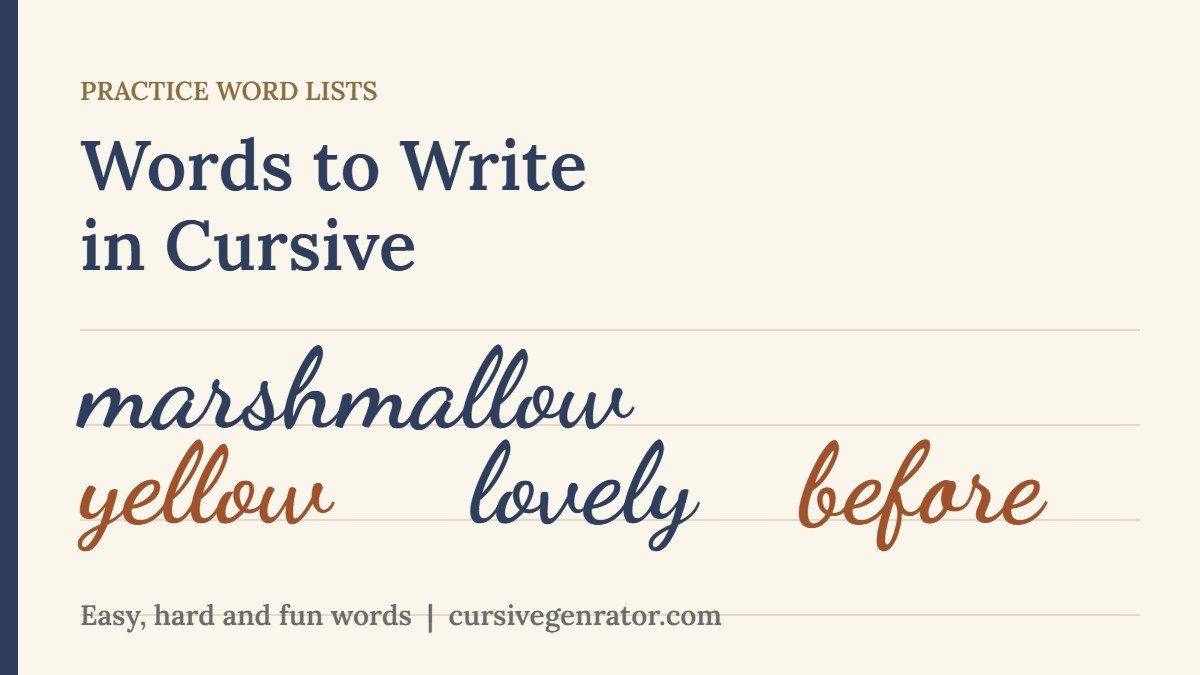
- yellow: Starts with a descender and ends with a double l and a high-join o and w. The descender join into the e, and then the two tall loops, make it one of the most demanding common words.
- puzzle: Contains a descender at the start, a double z with tails below the line, and an l and e at the end. The z is one of the least practiced letters, so it stands out.
- quick: The q has a descender and then a u, which together form a distinctive join. The c and k at the end are both easy to misjudge, since k has its own small loop.
- before: The b begins with a tall loop and ends in a rounded bowl, then the e, f, o, r and a final e. The f descends below the line, so the o that follows must start from the baseline join, not from the descender.
- floor: The f loops tall and drops below the line. The l rises to the same height as the f. Then come two o letters in a row. The first o exits high, which carries the pen into the second o, and then into the r.
- process: The p drops below the line and loops back up, then the r, o, c and e, with two s letters closing the word. Check that the two s letters at the end are the same size.
- author: The a and u are both rounded, and the t joins with a baseline exit. After the t comes a tall h loop, then an o with a high exit into the r. Cross the t at the end.
- squirrel: Almost every difficult feature appears here: a small s, a q with a descender, a u, an i, two r letters and a double letter at the end. If you can write this one cleanly, most other words will feel easier.
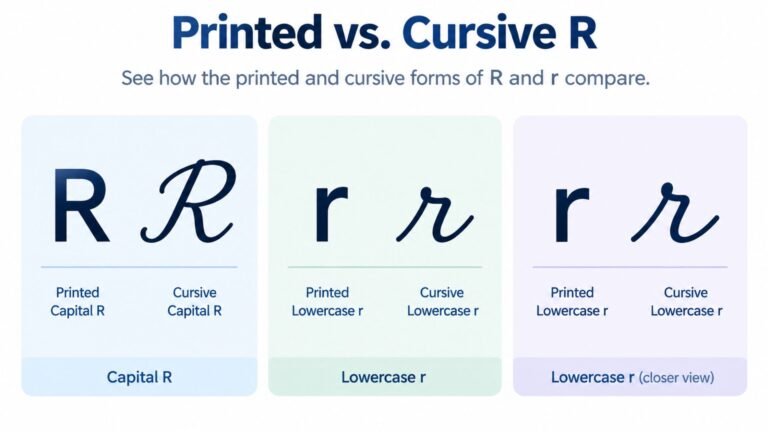
- Words with r and s inside them are consistently the hardest, because those two letters break the normal shape pattern. If a word keeps going wrong, find the r or s in it first.
Fun and Satisfying Words to Write in Cursive
People who like writing cursive tend to agree on what feels good. These words repeat the same round shapes in a row, so the pen moves in a steady rhythm.
- Lovely, hello, mellow, willow and balloon: Repeated l and o letters give a smooth, bouncing movement.
- Marshmallow: The m, two l letters and a closing w make a long, flowing word with plenty of loops.
- Jellyfish: A j with a descender at the start, a double l in the middle and an f with a loop through the line give you a good mix of tall and low letters.
- Melody and lullaby: Soft, round letters throughout, with few sharp changes of direction.
- Moon, noon and mom: Short, round and made almost entirely of humps and ovals. They are very forgiving words for slow practice.
- Wonderful: A long word whose high joins between w, o and n and tall f and l loops make it satisfying to finish in one line.
- These words are useful beyond fun. A word made of one repeated shape trains consistency, which is the skill that makes handwriting look neat.
Pretty, Positive and Kind Words to Write in Cursive
Cursive is often used on cards, labels, journal pages and quotes, so the words people choose tend to be warm ones. These are good practice because you are likely to use them again.
- Love, hope, grace, joy and peace: Short and friendly, with a mix of loops and humps.
- Kind, gentle, grateful and blessed: Longer words that test tall letters like k, l and b alongside rounded ones.
- Dream, bloom, smile and sunshine: A good range of joins, including the high join from o and the tall loop of l.
- Happy, lucky and lovely: Words with double letters or descenders, useful as a step up from the easy list.
- Write each one slowly and check the spacing between letters first. Neat spacing makes a word look pretty more than any flourish does.
Words for Holidays and Special Occasions
Seasonal words are easy to motivate yourself to practice, because you have a reason to write them. For Christmas, joy, merry, noel, holly, snow, peace and bright are all short enough to practice and long enough to include a few joins. For birthdays and thank-you notes, thank you, happy birthday, congratulations and best wishes give you short phrases that make good practice for moving from one word to the next.
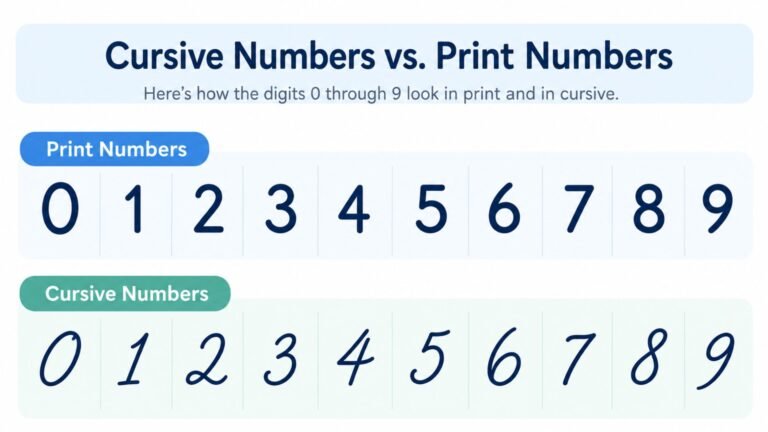
Capital letters matter here, since many greetings begin with one. The guide to capital cursive letters covers how to write each one. If you need to spell numbers as words, like “one,” “two” or “twenty,” the guide to cursive numbers explains how they fit in with the letters.
Double Letters and Repeated Shapes
Many of the words above contain doubled letters: little, yellow, balloon, floor, process, squirrel. The rule is to treat the second letter as a fresh letter that starts where the first one ended, rather than copying the first one as a separate shape.
Double l is the most forgiving, since both loops rise to the same height and the second follows the first. Double o is trickier, since the first o has to leave through a high exit and the second has to begin from that exit without a pause. Double s should stay small and even. When a double letter looks wrong, the cause is nearly always height, so check that both letters in the pair are the same size before looking for any other problem.
Common Mistakes When Practicing Words
- Stopping to add crossbars and dots mid-word. Add them after finishing the word, so the pen stays on the paper while the word is written.
- Lifting the pen at the wrong spot. Lifting mid-word breaks the connection. Lift only at the end of the word.
- Joining high-join letters from the baseline. The o, v, w and b all exit at the top. Starting the next letter low makes the join look cramped.
- Letting words slope in different directions. Draw light slanted guidelines on your practice paper, and keep every word on the same angle.
- Writing too large. Large writing makes joins easier at first but builds the wrong habit. Aim for a consistent, moderate size from the start.
A Practice Routine for Words
- Pick five easy words and write each one ten times, slowly. Aim for even height and consistent joins, not speed.
- Add two hard words each session. Choose them from the list above, based on which ones you got wrong last time.
- Move to short phrases built from words you already know, like “and the,” “with that” or “from the.” Phrases test whether the last letter of one word sets up the first letter of the next one.
- Finish with one fun word, so the session ends on something you enjoy.
- Keep sessions to ten or fifteen minutes. Handwriting improves through repetition spread across days, not through one long session. For the deeper rules about how letters link in general, see the guide to cursive words and connecting letters.
See Any Word in Cursive First
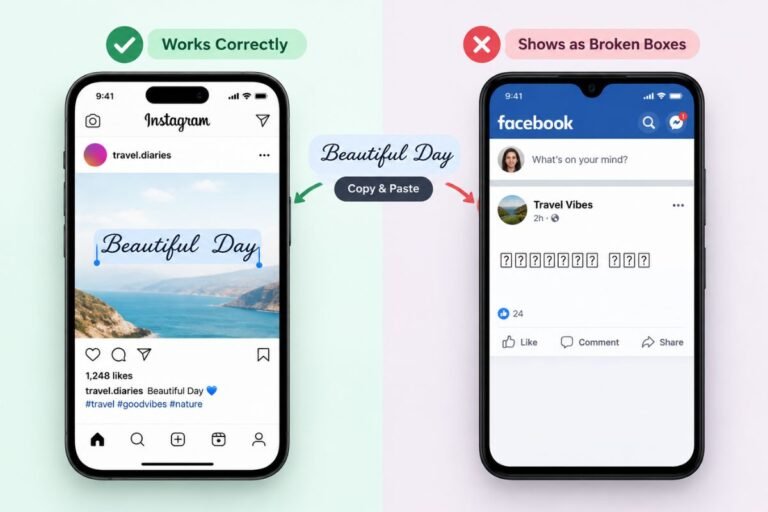
Writing by hand is the goal here, but it often helps to see what a word should look like before you write it. Cursive Generator converts anything you type into cursive-style text and previews it across several script fonts, so you can look at the shape of “before,” “marshmallow” or your own name before writing it on paper. It is a visual reference, not a replacement for practice, and it works well alongside the word lists above.
Frequently Asked Questions
What are good words to practice in cursive?
Start with short, common words like “is,” “in,” “at,” “and,” “the” and “with.” They teach the basic joins and are the words you will write most often. Then add a few harder words with doubled letters or descenders, and a few fun ones for motivation.
What are the easiest words to write in cursive?
Short words made of baseline-join letters are the easiest, such as “in,” “it,” “is,” “an,” “at” and “as.” They have no high joins or loops, so they let you focus on keeping an even height and a steady exit stroke.
What are the hardest words to write in cursive?
Words that contain r, s, z, q or a descender followed by a tall loop are usually the hardest. “Yellow,” “puzzle,” “squirrel” and “process” are good examples, because they combine several awkward joins in a short space.
What are the most satisfying words to write in cursive?
People often pick words made of repeated round shapes, like “lovely,” “hello,” “balloon,” “willow” and “marshmallow.” The pen moves in a steady rhythm, which makes them pleasant to write.
How do you write words in cursive?
Write each word in one continuous stroke, joining every letter to the next without lifting the pen. Lift only at the end to add dots and crossbars. If a join feels awkward, check whether the previous letter exits at the baseline or at the top, and start the next letter from that point.
Do you connect every letter in a word?
In standard cursive, yes. Each lowercase letter ends with an exit stroke that carries into the next letter. Capital letters are usually written on their own and sit slightly apart from the lowercase letters that follow.
How do you spell words in cursive?
Spelling stays exactly the same as in print. What changes is the shape of each letter and how the letters join. Write the word in print first if you are unsure of the spelling, then write it again in cursive.
Do you cross the t and dot the i while writing the word?
No. Finish the whole word first, then go back and add the crossbars and dots. That keeps the pen on the page during the word, which is what makes the writing connected and fast.
Conclusion
The right words make cursive practice faster and more enjoyable. Learn the four joins, start with short easy words, add hard words that target your weak spots, and keep a few fun or pretty words in the mix so you want to keep going. A few weeks of short, regular sessions on these lists will do more for your handwriting than many pages of isolated letters. To preview how any word looks before writing it by hand, try Cursive Generator and compare it across several real script fonts.
5 Comments